| |
|
|
| |
| |
| Welcome to www.worldwar-1.net! |
 |
World
War 1, also known as the First World War or the Great War and the War to End All Wars, was a world
conflict lasting from 1914 to 1919, with the fighting lasting
until 1918. The war was fought by the Allies on one side, and
the Central Powers on the other. No previous conflict had mobilized
so many soldiers or involved so many in the field of battle.
By its end, the war had become the second bloodiest conflict
in recorded history.
World War 1 became infamous for trench warfare, where troops were confined to
trenches because of tight defenses. This was especially true of the Western Front.
More than 9 million died on the battlefield, and nearly that many more on the
home fronts because of food shortages, genocide, and ground combat. Among other
notable events, the first large-scale bombing from the air was undertaken and
some of the century's first large-scale civilian massacres took place, as one
of the aspects of modern efficient, non-chivalrous warfare.
I hope you will enjoy viewing
worldwar-1.net
and find its information both
helpful and interesting. The
website includes an exhaustive day by day timeline,
covering every event
that occured during World
War 1, in chronological order from 1914
through to 1919, which gives a fascinating insight into what
was arguably the first industrial war in our history! |
| |
|
| |
|
|
 |
|
 |
More
detail to the websites timelines has recently been added, particularly
those for
1918 and 1919
which have received a lot if new data. Work also continues
on other projects, one of which is a timeline of events
immediatley after World War 1. I shall update this and
other projects in due course.
Webmaster
|
|
5th September 1914
First Battle of the Marne begins.
9th September 1914
First Battle of the Masurian Lakes begins.
10th September 1914
First Battle of the Marne ends in a French Victory, thus halting the German advance towards Paris, which results in stalemate.
14th September 1914
Russia loses the First Battle of Masurian Lakes. First Battle of Aisne begins. Troops starts to construct trenches across the entire length of the western front.
17th September 1914
Austro-German forces launch an attack into western Poland
5th September 1915
Tsar Nicholas takes commands of Russian armies.
15th September 1915
British forces use gas in battle near Loos, but shifting winds cause 60,000 British casualties.
22nd September 1915
The Second Battle of Champagne begins.
15th September 1916
Tanks introduced for the first time on the Somme battlefield by the British.
20th September 1916
Russia's Brusilov offensive in Carpathia comes to an end, having nearly knocked Austria-Hungary out of the war.
1st September 1917
German troops break through the northernmost end of the Russian front during the Riga offensive.
19th September 1918
The British begin an offensive against Turkish forces in Palestine, the Battle of Megiddo.
26th September 1918
The Battle of the Vardar is fought against the Bugarians by Serb, Czech, Italian, French and British forces. The Meuse-Argonne offensive begins. this wll be the final Franco-American offensive of the war.
28th September 1918
Belgian forces launch an offensive at Ypres.
29th September 1918
Bulgaria concludes armistice negotiations with the Allies. |
| |
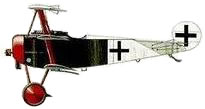
| German
Fokker DR.I |
 |
| The
Fokker DR.I triplane was built after the Sopwith Triplane. While
not as fast as contemporary biplanes, the Dreidecker could easily
outclimb any opponent. Small, lightweight and highly maneuverable,
it offered
good upward visibility and lacked the traditional bracing wires that could
be shot away during combat. This combination of features made
it an outstanding
plane in a dogfight. When the DR.I first entered service, antagonists scoffed
until pilots like Werner Voss Flying a prototype, shot down 10
British aircraft
in 6 days of aerial combat during September 1917. Unfortunately, the DR.I
was not without problems. By the end of October 1917, it was
temporarily
withdrawn from service when several pilots, including Heinrich Gontermann,
were killed as a result of wing failures. Despite structural
improvements,
the Fokker triplane's reputation among German airmen never recovered. |
|
| |
|
|
| |
|
|